
 Call 480-699-7400
At a glance
Read infographic
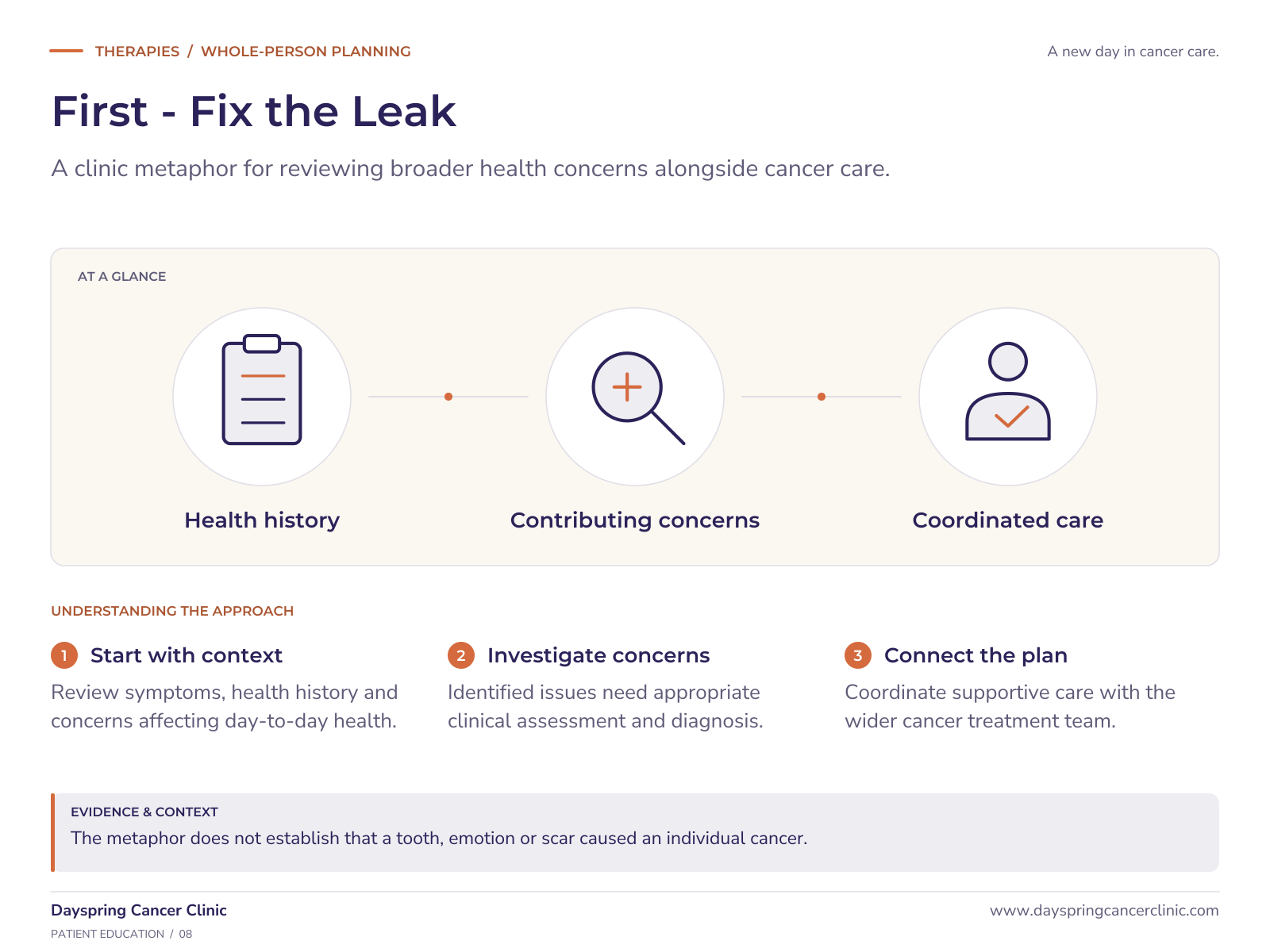
A clinic metaphor for reviewing broader health concerns alongside cancer care.
Key points
- Health history
- Contributing concerns
- Coordinated care
Understanding the approach
Start with context
Review symptoms, health history and concerns affecting day-to-day health.
Investigate concerns
Identified issues need appropriate clinical assessment and diagnosis.
Connect the plan
Coordinate supportive care with the wider cancer treatment team.
Evidence & context
The metaphor does not establish that a tooth, emotion or scar caused an individual cancer.
When people contact Dayspring Cancer Clinic for information, they usually ask about therapies and treatments. However, this is not always the most important question. What can be much more important to ask? “Why did I get to this condition?” We believe the importance of asking this can sometimes provide us with a so-called silver bullet, or missing link.
This is not to devalue the importance of using the very best therapies, but to give a much better idea of how to correct what has happened. We liken it to waking up one morning and opening the basement door to see that the basement carpet is wet. Well, one could get on the phone and have a workman come over to patch the walls, paint, and replace the carpet. Then the next morning one opens the basement door to see that once again the carpet is wet. It makes more sense to figure out where the leak is coming from and fix the leak BEFORE doing the repairs. Then the repairs will last.
So, what are the “leaks” causing cancer? Here are common important causes:
-
teeth (especially root canals, cavitations)
- heavy metals
- emotions
-
scars
-
low thyroid
- sympathetic dominance
-
toxins
Certainly, this is not a complete list, but it does call out many of the common, major sources of underlying problems that can sabotage the best intentions. Experience has shown us that cancer therapies and treatments are much more effective when these are addressed first.
One patient’s history illuminates this wonderfully. She was trained as a dentist in London, England, and practicing dentistry there. At age 35, she was diagnosed with stage IV breast cancer and treated conventionally in London. After failing conventional treatment, she went to Nevada for alternative cancer therapy. Failing there, she went to Mexico for more alternative cancer therapy. Failing there, she came to Dayspring. When she came through our door, she was in a wheelchair and on 90 mg of morphine, plus Vicodin®, for breakout pain.
In the first week at Dayspring we told her she had a bad tooth and an infection. But she did not initially wrap her mind around how she, as a dentist, could have a bad tooth. So, we treated her for two months and could only stabilize her and keep her from passing. At the end of two months, she agreed to have a tooth pulled and a PICC line replaced (we had also found that her line was infected). At the end of the next month she was walking and off all morphine and Vicodin.
What did we at Dayspring do differently for such a remarkable turnaround? It wasn’t a different treatment. We fixed the “leak in the basement” so our therapies could bring about a successful resolution of her cancer.
We strongly encourage our patients to have their “leak” fixed so our therapies will have a lasting impact.